
By Phil Wandrei, Sr Product Marketing Manager
Tape has always been valued for what it does best: long-term, cost-effective retention at scale. But the way organizations operate tape environments has changed. Archives are bigger. Retention windows are longer. Teams are leaner. And when a restore or compliance request arrives, there’s less tolerance for “we’ll figure it out when it breaks.”
That’s why the next phase of tape library management can’t be purely reactive. It needs to be data-driven and designed to spot issues early, reduce guesswork, and help teams act before a minor performance issue turns into a missed backup window or a delayed restore. LumOS 3.0 is built precisely for that.
From Library Management to Library Intelligence
Spectra LumOS Library Management Software has always focused on making tape library operations simpler and more reliable. With LumOS 3.0, the focus expands beyond managing the library to understanding what’s happening inside it continuously, automatically, and in a way that helps teams make faster, more informed decisions.
At the heart of this release is a shift toward operational intelligence. LumOS 3.0 collects far more health and performance information during normal tape operations, building a richer picture of drive and media behavior over time. Instead of relying on isolated events or manual troubleshooting after an issue, teams can use this insight to identify early warning signs — before they impact production.
Built-In Proactive Diagnostics
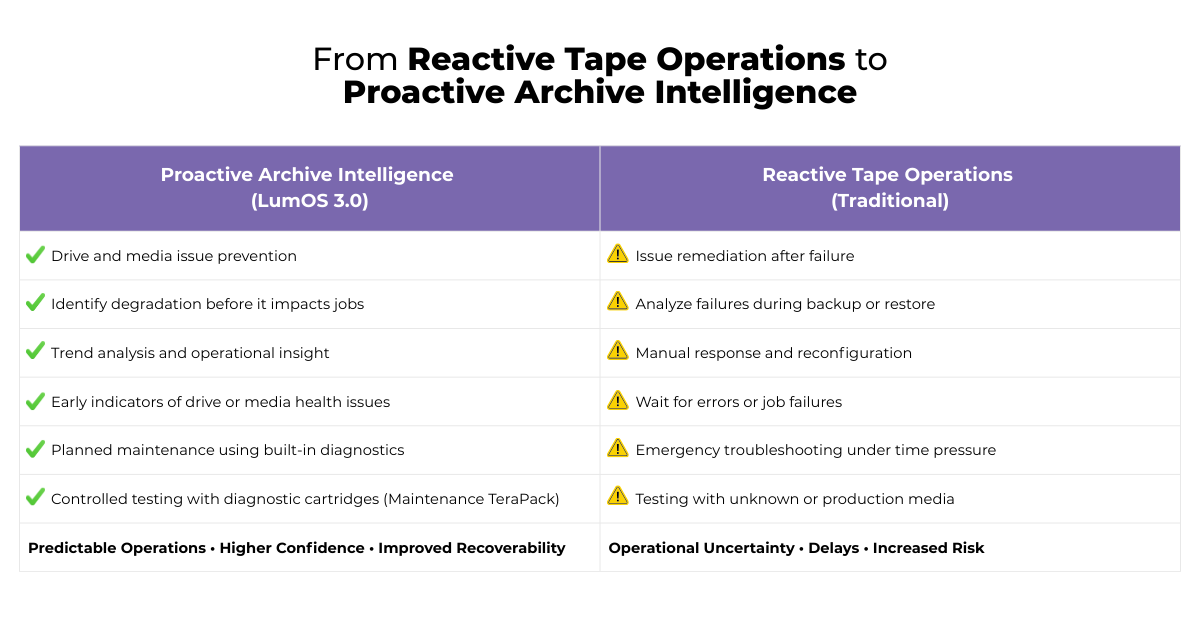
Drive and media issues rarely announce themselves at a convenient time. A drive can slowly degrade. A cartridge can develop problems that only surface during reads. And in the moment — when a job fails or performance drops — teams often must decide quickly: Is it the drive? The media? Normal behavior?
LumOS 3.0 helps remove that uncertainty by bringing diagnostic capabilities directly into the platform experience. Drive testing is now built into LumOS 3.0, enabling on-demand checks that validate drive behavior through a controlled, consistent test process. To ensure accurate and repeatable results, LumOS drive tests use a dedicated Maintenance TeraPack with Spectra Diagnostic Cartridges. This new TeraPack is designed specifically for diagnostics, ensuring that only clean, known-good media is used when testing a drive — eliminating ambiguity caused by worn or unknown tapes.
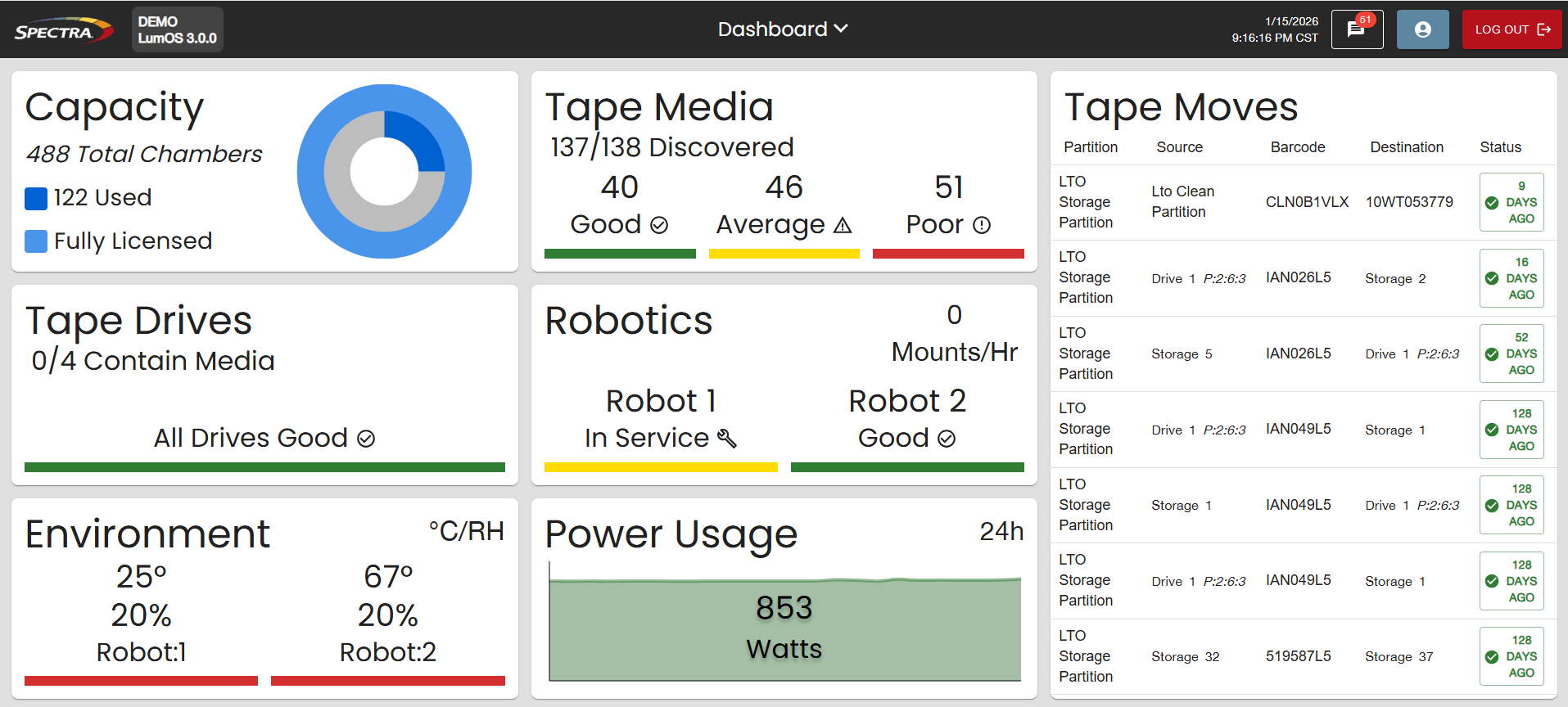
When used with Spectra Certified Media, LumOS 3.0 can collect and report a more consistent and meaningful set of operational data points. This deeper visibility improves understanding of long-term drive and media behavior, strengthens confidence in health indicators, and supports more reliable, durable data retention throughout the archive lifecycle.
Because the LumOS software also tracks a much broader set of operational metrics in everyday use, diagnostic results are grounded in real-world performance — not just isolated test runs. The result is clearer insight, faster root-cause identification, and greater confidence in the actions taken.
Turning Metrics into Action
More data isn’t helpful unless it leads to action. LumOS 3.0 connects the dots between what the library software observes and what an administrator should do about it.
By collecting deep operational insight across drive and media activity, LumOS software helps teams recognize patterns — degradation, abnormal performance, or conditions that deserve attention — before issues become disruptive. That’s especially valuable for organizations running large archives, or for teams managing tape alongside many other infrastructure responsibilities. The goal is simple: keep the archive reliable, predictable, and ready when it matters most.
Broader Coverage Across Spectra Environments
LumOS software continues to support Spectra TFinity Plus, T950, and Cube libraries. With the LumOS 3.0 release, support is expanded to include Spectra T200, T380, and T680 libraries, extending advanced diagnostics and lifecycle management capabilities across a broader range of Spectra environments.
A Foundation for What Comes Next
LumOS 3.0 reflects a broader direction: more automation, more intelligence, and more confidence in long-term operations. As tape environments grow, the most critical capability isn’t just storing data — it’s ensuring that data remains consistently recoverable and that the infrastructure stays healthy over years of use.
LumOS 3.0 is a meaningful step toward that future, representing a smarter, more proactive way to run tape libraries so that customers spend less time troubleshooting and more time trusting the archive.
If you’re planning a LumOS Software upgrade or want to understand how these capabilities apply to your environment, your Spectra team can help you map the right operational approach for your library and workflows.