
Chris McCall, Director of Product Marketing, Spectra Logic
For most of my 25+ year career in the data storage industry, organizations have responded to growing data by buying more storage.
Today, I believe that equation is changing.
Flash and disk capacity are under enormous pressure from growing data volumes, AI infrastructure demands, constrained availability, and rising prices. At the same time, organizations already have significant amounts of valuable but inactive data consuming capacity on storage systems designed and priced for active workloads.
That is the problem Spectra Storage Reclaim™ was created to address.
Storage Reclaim is a storage capacity optimization solution designed to help organizations recover flash and disk capacity they already own and extend the life of their existing storage investments. Instead of automatically adding more infrastructure, organizations can first determine how much capacity can be reclaimed from data that no longer requires premium storage performance.
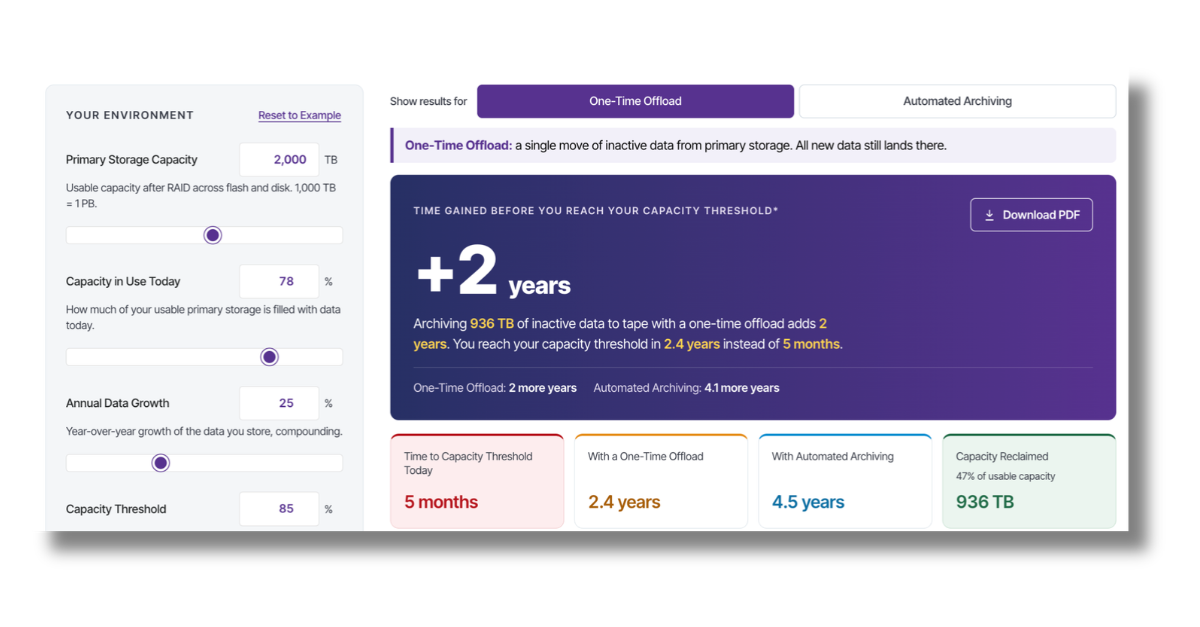
Storage Reclaim follows a straightforward, assessment-led process:
- Analyze. First, a read-only analysis measures how much data is inactive or infrequently accessed based on its age and access patterns.
- Identify. Your policies determine which data is appropriate to move from flash and disk to a more economical, protected tape-based storage tier.
- Move & Manage. Qualified inactive data is moved according to policy using Spectra StorCycle® or an integrated data-management technology, while maintaining the visibility, access, and recall required by the unique customer environment.
- Reclaim. The resulting flash and disk capacity is returned to active workloads, AI initiatives, and future growth, helping extend the useful life of storage infrastructure already in place.
Storage Reclaim supports an ecosystem of data-management technologies including Spectra BlackPearl® Object Gateway and Spectra tape storage.
Why Tape Matters More Than Ever
Tape storage has never been more relevant to enterprise storage infrastructure than it is today.
While tape is one of the industry’s most established technologies (tape was first used to store compute data in 1951), the challenges facing modern data centers make tape’s fundamental benefits increasingly valuable.
The advantages of tape data storage include:
- Economical, long term data preservation
- Air-gapped protection for cyber resiliency
- Long media life, supporting decades of reliable data retention
- Low energy consumption, reducing power, cooling, and carbon impact
- High-capacity storage, enabling organizations to retain more data within a smaller data center footprint
Organizations are generating and retaining enormous amounts of data, but not all of it needs the performance or economics of flash and disk throughout its lifecycle. At the same time, IT teams are balancing AI growth, infrastructure costs, power constraints, long-term retention requirements, and the need to keep critical data better protected from cyber threats.
In modern data center environments, tape isn’t simply an archive technology. It is a strategic infrastructure tier that allows organizations to put data on the storage technology that makes the most sense based on how that data is actually being used.
Flash and disk can remain focused on workloads requiring performance and frequent access. Inactive data can move to an economical, protected tape tier where it can remain available when needed without continuing to consume valuable higher-performance capacity.
That is ultimately what makes Storage Reclaim compelling. It isn’t about replacing the storage infrastructure you already own. It’s about using that infrastructure more effectively and economically. Before your next capacity expansion or refresh, there are a few simple questions worth asking:
- How much of your inactive data is occupying your primary storage iters?
- How much storage capacity could you reclaim from the infrastructure you already own?
Storage Reclaim helps answer these questions, then gives organizations a practical path forward.