
Phil Wandrei, Product Marketing Manager, Spectra
Erasure coding is a powerful and proven technology.
In always-on, disk-based environments, it improves durability and storage efficiency by dividing data into fragments, adding parity, and distributing those fragments across many devices. When components fail — as they routinely do in large-scale disk systems — missing fragments can be reconstructed in the background using parallel access and abundant compute.
Within its intended domain, erasure coding delivers high durability and storage efficiency with predictable rebuild behavior.
The problem arises when that domain is misunderstood.
Applying erasure coding to tape-based archives is not simply a design choice. It is a category error.
The Assumptions Behind Erasure Coding
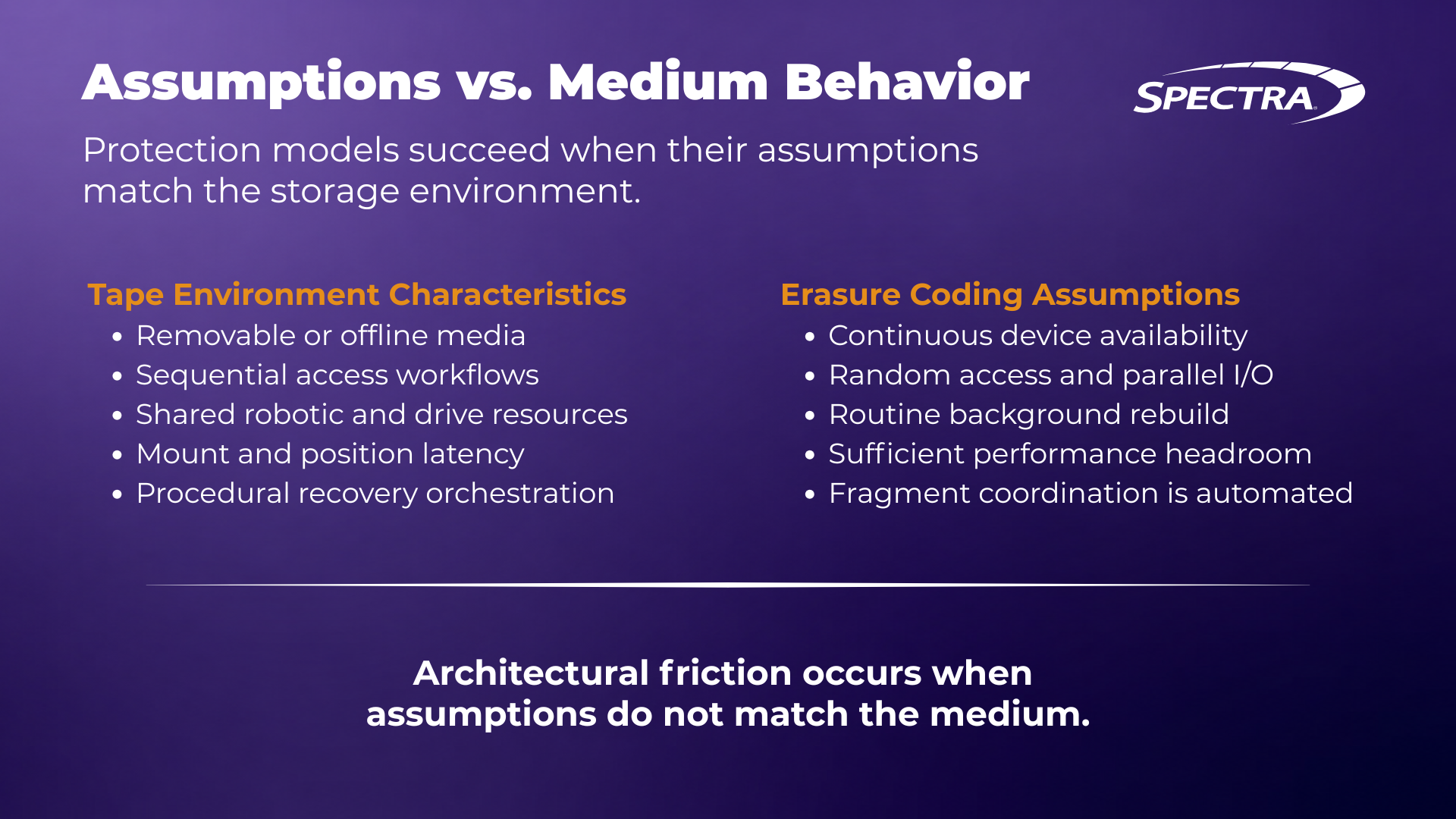
Erasure coding relies on several foundational conditions:
- Continuous device availability
- Random access and parallel I/O
- Automated, routine rebuild workflows
- Sufficient performance headroom to absorb reconstruction load
Disk and object storage platforms are engineered around these assumptions. Drives remain online. Failures are expected. Rebuild is a background activity. Parallelism is abundant.
These characteristics are not incidental — they define the conditions under which erasure coding can deliver high durability with improved capacity efficiency.
Tape environments operate differently.
Tape Is Not “Slow Disk”
Tape is sequential, removable, and often offline by design. These are not weaknesses — they are the very attributes that make tape valuable for long-term retention and cyber resilience.
But those fundamental attributes define how recovery is carried out.
Tape systems are optimized for predictable streaming workflows, not for assembling fragments from multiple cartridges simultaneously. Drives and robotics inside a library are shared, high-value resources. Cartridges are abundant; mounts and seeks are not.
When erasure coding is applied to tape, the durable unit shifts from a complete copy to a coded set: fragments, parity, metadata, and layout rules that must be interpreted together.
That shift replaces independently recoverable units with interdependent fragments.
From Independent Copies to Interdependent Fragments
Replication produces complete, independent copies. Each copy can be mounted and restored deterministically.
Erasure coding requires assembling a sufficient set of fragments, often distributed across multiple cartridges. Recovery depends not only on media integrity but also on the precise coordination of fragments, metadata, and interpretation logic.
In disk systems, this coordination is routine and automated. In tape environments, it introduces additional mounts, additional seeks, and additional orchestration steps — all of which consume valuable library resources.
During recovery events — when systems may already be under pressure — these differences directly affect real-world recovery time.
The durability math may still look strong. The operational reality becomes slower, more complex, and less predictable.
The Recoverability Horizon Narrows
Over long retention periods, the consequences deepen.
Erasure coding encapsulates data inside a specific encoding scheme. Fragments must be interpreted using the correct reconstruction logic. Static configurations can tie data recoverability to a particular system design. Over time, this creates long-term dependency on proprietary software, metadata structures, and fragile operational knowledge.
As organizations evolve — infrastructure changes, hardware generations shift, personnel rotate — tightly coupled layouts shorten the recoverability horizon. Restoration becomes increasingly dependent on recreating the original environment or preserving specialized knowledge.
Replication minimizes that risk because the durable unit is complete and self-contained. Copies can move across generations more easily. Recovery remains procedural rather than reconstructive.
This distinction does not make erasure coding flawed. It makes it domain specific.
Match the Model to the Medium
Erasure coding excels in always-on, parallel disk environments designed to absorb rebuild activity as part of normal operation.
Tape-based archives are built for different priorities: long-term retention, offline survivability, deterministic workflows, and resilience over decades.
When protection mechanisms assume one operational model and are applied to another, architectural friction follows, placing organizations at risk of a worst-case scenario: data loss. The most resilient archive designs align the protection model with the medium’s behavior. They evaluate success not by theoretical efficiency, but by whether data can be restored — predictably and independently — years after initial deployment.
Erasure coding is powerful where it belongs.
Tape belongs to a different category.
For a broader exploration of how recoverability reshapes archive protection strategy, we examine these principles in more detail in our white paper, Recovery First: Why Archive Protection Must Match the Medium.