

Phil Wandrei, Product Marketing Manager, Spectra
In archive design, most conversations revolve around durability. Increasingly, they also include data recoverability — the practical ability to restore complete, usable data when required.
But there is a third dimension that receives far less attention.
Time.
Archives are not built for fiscal quarters. They are built for decades. As the years pass, organizations evolve, platforms change, vendors shift direction, and teams turnover. What remains constant is the expectation that the data will still be accessible — fully and predictably — when it is needed.
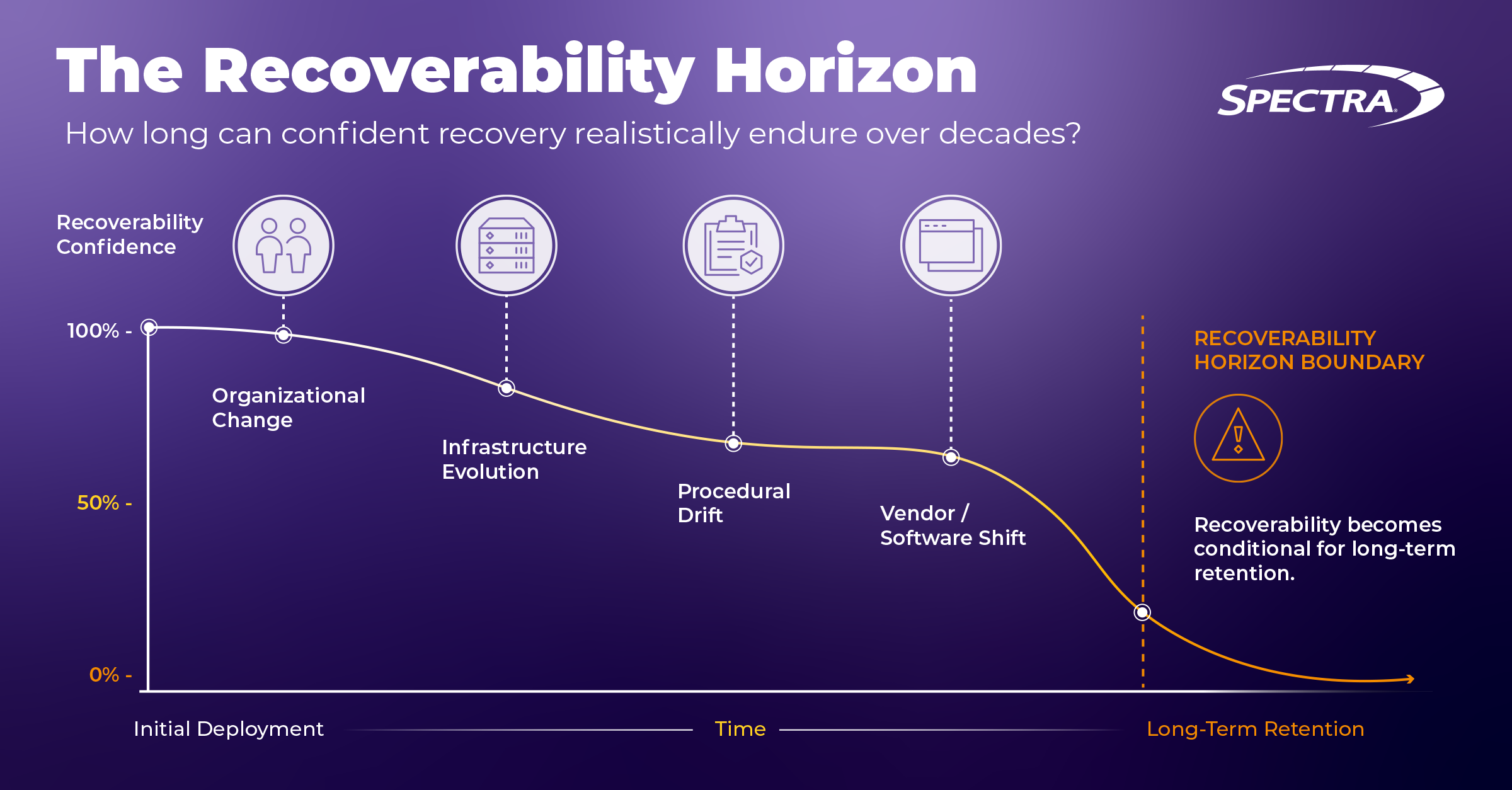
This is where the concept of the recoverability horizon becomes useful — a way to evaluate not just whether data survives, but how long it remains confidently restorable.
Long-Term Archive Recoverability
Recoverability is often discussed as a point-in-time capability. If a system fails today, can the data be restored within the defined recovery time objective?
That question is necessary but incomplete.
A more consequential question is this: How long can teams reasonably expect to recover this data without reconstructing the original environment?
The recoverability horizon is the practical lifespan of confident restoration. It reflects how long an archive can remain independently recoverable without requiring precise reconstruction of historical configurations, proprietary layouts, or obsolete software environments.
Two systems may appear equally durable. They may even appear equally recoverable today. But their recoverability horizons can differ significantly.
What Shapes the Recoverability Horizon?
Several architectural factors influence how long recoverability can be sustained:
- Dependency on proprietary layouts or metadata. If interpretation requires a specific platform or software version, the horizon narrows.
- Configuration rigidity. Systems that cannot evolve without preserving exact structural assumptions may accumulate long-term risk.
- Operational complexity. Workflows that depend on tightly coordinated steps across multiple components are harder to preserve over time.
- Platform and vendor continuity. If recoverability assumes ongoing support from a single-vendor ecosystem, organizational change becomes a factor in archive viability.
- Degree of coupling between data and interpretation logic. The more tightly data is bound to system-specific reconstruction rules, the shorter the horizon tends to be.
Individually, these factors may appear manageable. Over time, they compound — often invisibly — until recovery becomes slower, more complex, and less predictable.
Media Survival is Not Enough
Archives can fail even when the media itself remains intact. Long-term preservation depends on three elements remaining aligned:
- The media
- The interpretation
- The recovery process
When these elements drift apart, recovery becomes conditional rather than deterministic.
For example, in scientific and HPC environments, teams often rely on archived datasets to revisit prior simulations or validate results years later. If those datasets depend on obsolete software or undocumented workflows, recovery may require reconstructing an entire historical environment — turning what should be a routine retrieval into a time-consuming engineering effort.
Over 10-20+ years, hardware generations change. Library configurations evolve. Data volumes grow. Sites consolidate. Personnel rotate. Shortcuts emerge. Context is lost. Institutional knowledge fades.
By comparison, architectures that preserve complete, independently recoverable units tend to age more gracefully. They reduce reliance on exact historical reconstruction and extend the recoverability horizon by minimizing dependency between data and the systems required to interpret it.
Designing for Decades, Not Deployment
An archive strategy often succeeds or fails long after its initial deployment. Decisions made in the name of efficiency today can shape recovery complexity years later.
A recoverability-first approach asks:
Will this archive remain practically restorable after organizational change?
Will recovery require deep system archaeology? Will future teams understand how to retrieve this data under stress?
These are not abstract questions. They determine whether an archive remains an asset or becomes a dependency.
While durability describes statistical survival, recoverability describes practical restoration. The recoverability horizon describes how long restoration can remain confidently achievable.
For long-term archives, the recoverability horizon may be the most important metric.
When evaluating protection strategies, measure not only whether data can be recovered — but also how long that confidence can realistically endure.
An archive that cannot be confidently restored is not preserved — it is simply consuming storage.
For a broader framework on aligning archive protection with recoverability over decades, we explore these principles in more detail in our whitepaper, Recovery First: Why Archive Protection Must Match the Medium.