Your Fastest Storage is Filling with Inactive Data
Your data keeps growing. But flash and disk are getting harder and more expensive to buy. Inactive unstructured data occupies capacity that AI, analytics, and other active workloads need. Storage teams face pressure to expand or refresh storage sooner, while continuing to pay higher long-term retention and protection costs.
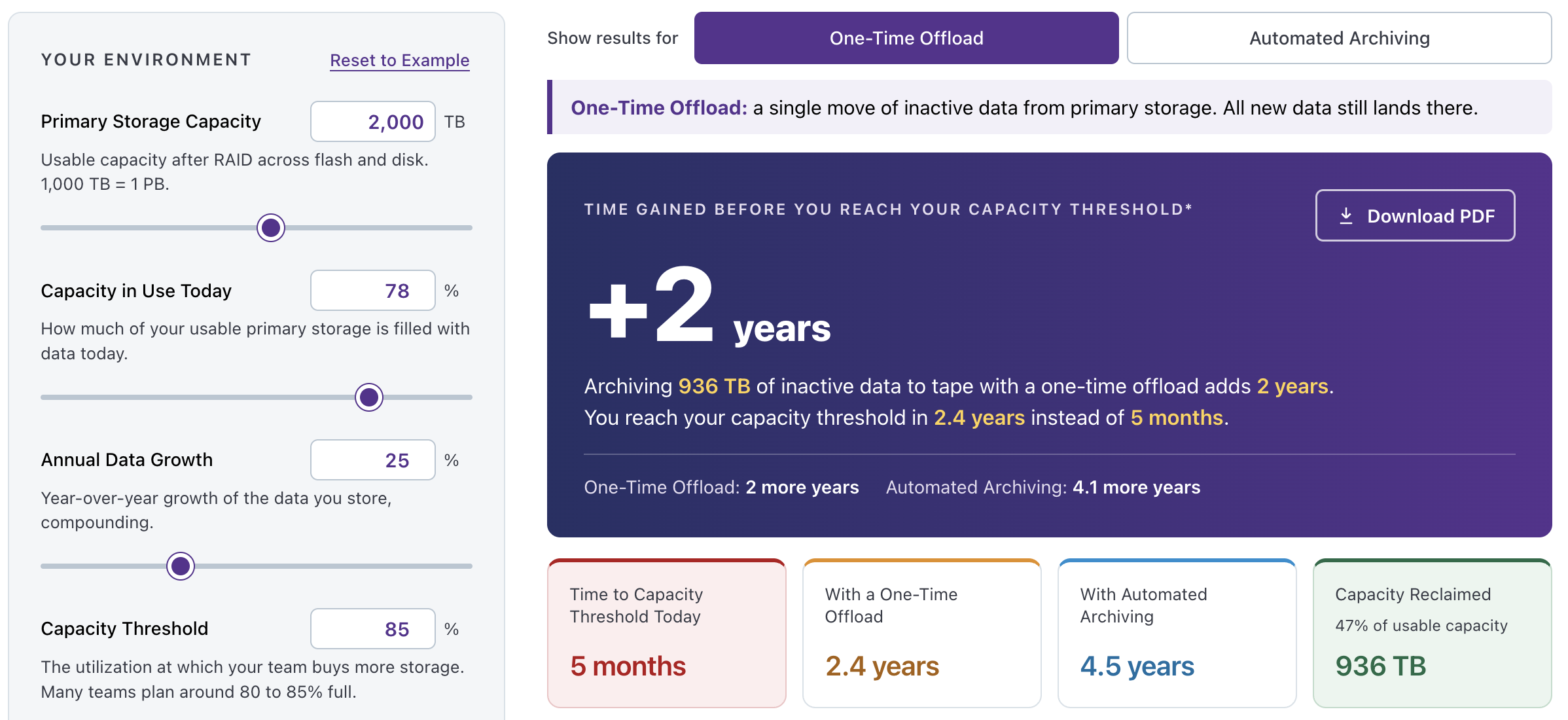
Before buying more flash or disk, use the Storage Reclaim calculator to find out how much existing capacity is tied up by your inactive data — and how much you can get back.
Spectra Storage Reclaim is a storage capacity solution for inactive data. It starts with an assessment and analysis of your environment, identifies data that no longer needs disk or flash, and moves and manages that data to protected, air-gapped tape. Flash and disk capacity returns to active workloads, while the inactive data stays visible and accessible.
By extending the useful life of existing storage investments, Spectra Storage Reclaim helps organizations delay costly capacity expansions, reduce long-term retention costs, and strengthen cyber resilience.
Choose the Path That Fits your Environment
Storage Reclaim supports more than one way to move data, so you can build on the tools already in your environment.
StorCycle® provides policy-based data lifecycle management.
Spectra Storage Reclaim follows a four-step process to identify inactive data, move it to protected storage, and return valuable flash and disk capacity to active workloads.
1
Analyze
Assess storage utilization, data age, and access patterns to understand how much storage capacity is occupied by inactive data and identify potential reclamation opportunities.
2
Identify
Set policies to determine which inactive data qualifies for movement based on access requirements, retention needs, and business value.
3
Move & Manage
Move qualified data to economical, air-gapped tape storage using policy-based data management while maintaining visibility, access, and retrieval.
4
Reclaim
Return reclaimed flash and disk capacity to active workloads and future growth, extending the useful life of existing storage infrastructure.
What You Get When You Reclaim
More Room, More Runway
Free up flash and disk capacity for active workloads, delaying your next storage expansion or refresh.
Lower Long-Term Costs
Retain inactive data at tape economics instead of paying flash or disk economics indefinitely.
Stronger Cyber Resilience
Keep retained data on air-gapped tape, strengthening your cybersecurity stance.
Maintain Access
Retained data stays visible and recallable, with Amazon S3-compatible access through BlackPearl Object Gateway.
What Makes Spectra Storage Reclaim Work?
Spectra Storage Analyzer
Measures inactive data, reclaimable capacity, and storage runway in your environment, so planning starts with the facts rather than assumptions.
See how much capacity you can reclaim before moving data.
Flexible Data Movement
Move qualified inactive data with an approved data mover.
Amazon S3-Compatible Access
Keep retained data available to applications through BlackPearl Object Gateway.
Physical Air Gap
Keep retained data offline and protected from online threats.
Scalable Tape Retention
Design tape capacity to today's needs, then grow as retention needs expand.
Integrated Services & Support
Partner with a Spectra expert for analysis, implementation, and ongoing support.
Real-World Storage Reclaim Solutions
The University of Utah Center for High-Performance Computing needed a more resilient, affordable way to protect more than 30 PB of research data. Its tape-based solution includes Spectra Cube and BlackPearl Object Gateway. With Spectra, the University of Utah achieved $7 per terabyte, reduced power consumption, and supported long-term retention and data-protection best practices.
These implementations illustrate the economics and long-term data protection of the Storage Reclaim approach.
Storage Reclaim identifies inactive data occupying primary flash and disk storage and moves qualified data to a more economical storage tier, returning capacity to active workloads. Spectra Storage Reclaim moves inactive unstructured data to protected tape while keeping it visible, accessible, and recallable.
How can I reclaim primary storage capacity?
Start by analyzing utilization, data age, and access patterns to identify inactive data on flash and disk. Qualified data can then be moved to tape, returning primary storage capacity to AI, analytics, and other active workloads.
Should I reclaim storage capacity before buying more flash or disk?
Analyzing existing storage first can reveal how much capacity is occupied by inactive data and how much can be reclaimed. Reclaiming that capacity can extend storage runway and delay or reduce the need for your next storage expansion or refresh.
What data can be moved off my primary storage?
Inactive unstructured data that no longer requires flash or disk performance may qualify to move. Storage Reclaim analyzes utilization, data age, and access patterns. It then uses policies to determine which data should move to a tape library.
Can I still access data after it moves to tape?
Yes. Moved data remains visible, accessible, and recallable. BlackPearl Object Gateway provides Amazon S3-compatible object access to retained data.
How does Storage Reclaim reduce storage costs?
Storage Reclaim moves inactive data from primary flash and disk and retains it using tape economics. This frees higher-performance storage for active applications while reducing the cost of long-term retention.
How does Storage Reclaim extend storage runway?
Storage Reclaim returns existing flash and disk capacity to active workloads, giving organizations more time before they need additional primary storage capacity. The amount of additional runway depends on the existing environment and the amount of capacity that can be reclaimed.
How do I know how much storage I can reclaim?
Spectra Storage Analyzer measures inactive data, reclaimable capacity, and storage runway in your environment. An assessment can identify how much existing flash and disk capacity could potentially be recovered before data is moved.
What data movers work with Spectra Storage Reclaim?
Storage Reclaim supports Spectra StorCycle and third-party data movers such as Komprise, Starfish, and rclone. A Spectra Solutions Architect can help determine which data mover fits your unique environment.
What is the difference between adding storage capacity and reclaiming storage capacity?
Adding capacity expands a storage environment, often by purchasing more expensive disk and flash. Reclaiming storage capacity identifies inactive data already occupying primary flash and disk, moves qualified data to a more economical tape tier, and returns that existing capacity to active workloads.
top
Manage Consent
We value your privacy. We use cookies to enhance your browsing experience and analyze our traffic. By clicking "Accept" you consent to our use of cookies in accordance with our Cookie Policy.
Functional
Always active
The technical storage or access is strictly necessary for the legitimate purpose of enabling the use of a specific service explicitly requested by the subscriber or user, or for the sole purpose of carrying out the transmission of a communication over an electronic communications network.
Preferences
The technical storage or access is necessary for the legitimate purpose of storing preferences that are not requested by the subscriber or user.
Statistics
The technical storage or access that is used exclusively for statistical purposes.The technical storage or access that is used exclusively for anonymous statistical purposes. Without a subpoena, voluntary compliance on the part of your Internet Service Provider, or additional records from a third party, information stored or retrieved for this purpose alone cannot usually be used to identify you.
Marketing
The technical storage or access is required to create user profiles to send advertising, or to track the user on a website or across several websites for similar marketing purposes.